Implementation: Single linked list
In this lecture, we will develop a single linked list which is a simplification of the std::list. Note that the std::list is a double linked list which allows forward and backwards iteraitons over the list. For simplificaiton we use the single linked list and only implement the forward iterator. However, adding the backward iterator is not much more additional work.

Datastructure
Each element of type T is stored in a struct/class data and inside there is stored
- T element which is the element itself
- A pointer to the struct/class
template<typename T>
struct data{

data(T in){

element = in;
}

// Element of the type std::list<T>
T element;
// Pointer of type of the class/struct
data<T>* next = nullptr;

};
// Struct for our implementation of the list
template<typename T>
struct myList{

//Pointer to the first element
data<T>* first = nullptr;

myList(){}

myList(T in){

    first = new data<T>(in);

}

bool empty(){

    if (first == nullptr)
        return true;

    return false;
}

};
Initilaziation of a list
In [4]:
#include<list>
#include<iostream>
Out[4]:
In [5]:
// CST list
std::list<double> list;

// Our list
myList<double> mylist;
Out[5]:
In [6]:
std::cout<< list.empty() << " " << mylist.empty() << std::endl;
1 1
Out[6]:
In [7]:
list = {1};

mylist = myList<double>(1);
Out[7]:
In [8]:
mylist.print();
1
Out[8]:
Adding to the list
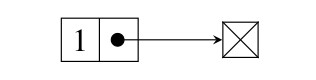
For a linked list, we always have to keep the pointer to the first element, since we use this pointer to access all other elements of the list. The pointer to the second element will be added to the next pointer of the first element.

In [9]:
list.push_back(2);

mylist.push_back(2);
Out[9]:
Implemententing the push_back function
void push_back(T element){

data<T>* tmp = first;

while (tmp->next != nullptr)
    tmp = tmp->next;

tmp->next = new data<T>(element);
}
Implementing the push_front function
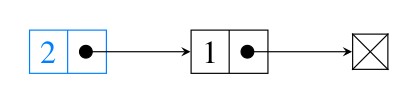
void push_front(T element){

data<T>* tmp = first;

first = new data<T>(element);

first->next = tmp;

}
In [10]:
list.push_front(-1);
mylist.push_front(-1);
mylist.print();
-1 1 2
Out[10]:
Printing the elements
In [11]:
#include<iostream>
Out[11]:
In [12]:
void print(std::list<double> list){
std::list<double>::iterator it;
for (it = list.begin(); it != list.end(); it++)
    std::cout << *it << " " ;

}
Out[12]:
In [13]:
print(list);
-1 1 2
Out[13]:
void print(){

data<T>* tmp = first;

while (tmp->next != nullptr){
    std::cout << tmp->element << " ";
    tmp = tmp->next;
    }
    std::cout << tmp->element;
}
In [14]:
mylist.print();
-1 1 2
Out[14]:
Remove the last element
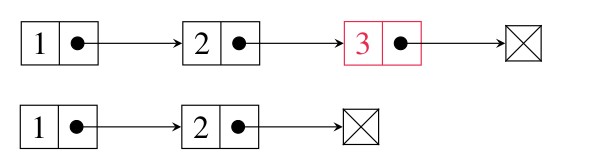
void pop_back(){

data<T>* tmp = first;
data<T>* prev;

while (tmp->next->next != nullptr){
    tmp = tmp->next;
    }

    delete tmp->next;
    tmp->next = nullptr;
}
In [15]:
list.pop_back();
print(list);
std::cout << std::endl;
mylist.pop_back();
mylist.print();
-1 1
-1 1
Out[15]:
Inserting a element
void insert(T element, size_t index){

data<T>* newNode = new data<T>(element);
data<T>* tmp = first;
data<T>* prev = nullptr;


//Case: Replace the head node
if (index == 0 && tmp != nullptr){
    newNode->next = tmp;
    *first = newNode;
    return;
}

//tmp = tmp->next;

// Case: search for the node
size_t i = 0;

while(i < index && tmp != nullptr){

    prev = tmp;
    tmp = tmp->next;
    i++;
}
if (tmp == nullptr)
    {
    std::cout << "Index " << index << " out of range" << std::endl;
    return;
    }

    prev->next = newNode;
    newNode->next = tmp;
}
In [16]:
std::cout << "Initial list" << std::endl;
mylist.print();
std::cout << std::endl;
std::cout << "Inserting at the beginning" << std::endl;
mylist.insert(1.0,0);
mylist.print();
std::cout << std::endl;
std::cout << "Inserting somewhere" << std::endl;
mylist.insert(40.0,1);
mylist.print();
std::cout << std::endl;
mylist.insert(40.0,10);
Initial list
-1 1
Inserting at the beginning
1 -1 1
Inserting somewhere
1 40 -1 1
Index 10 out of range
Out[16]:
Deleting a element
void remove(T element){

data<T>* tmp = first;
data<T>* prev = nullptr;

// Case I: Delete the head node
if (tmp != nullptr && tmp->element == element){

    first = tmp->next;
    delete tmp;
    return;
    }

while (tmp != nullptr && tmp->element != element)
    {
        prev = tmp;
        tmp = tmp->next;
    }

// Node was not found
if (tmp == nullptr)
        return;

// Unlink the node from linked list
prev->next = tmp->next;

// Free memory
delete tmp;

}
In [17]:
mylist.remove(2.0);
mylist.print();
1 40 -1 1
Out[17]:
Finding a element
bool find(T element){

bool found = false;

data<T>* tmp = first;

while (tmp != nullptr){

    if (tmp->element == element)
    return true;

    tmp = tmp->next;
    }

return false;

}
Example
In [18]:
#include <algorithm>
Out[18]:
In [19]:
auto p = std::find(list.begin(),list.end(),5.0);
Out[19]:
In [20]:
if ( p != list.end())
{
 std::cout << "Element " << *p << " was found!\n";
}
else
{
    std::cout << "Element was not found!\n";
}
Element was not found!
Out[20]:
In [21]:
p = std::find(list.begin(),list.end(),1.0);
Out[21]:
In [22]:
if ( p != list.end())
    std::cout << "Element " << *p << " was found!\n";
else
    std::cout << "Element was not found!\n";

std::cout << mylist.find(5.0) << std::endl;
std::cout << mylist.find(1.0) << std::endl;
Element 1 was found!
0
1
Out[22]: